“It’s normal. All women go through this.”
For years, that was what Priya heard every time she doubled over from period pain.
At 16, she missed school because of cramps so severe she vomited.
At 24, she planned work meetings around her cycle because she knew painkillers alone would not help.
At 31, after struggling to conceive for nearly two years, she finally heard a word nobody had mentioned before:
Endometriosis.
Her first reaction?
“How did nobody tell me this earlier?”
The truth is, Priya’s story is painfully common.
Across India, countless women grow up believing severe menstrual pain is simply part of womanhood. Family members normalise it. Friends joke about it. Society expects women to quietly tolerate it.
But here is the reality many women are never told:
Extreme period pain is not always normal.
Sometimes, it is the body signalling an underlying condition – and one of the most commonly overlooked causes is endometriosis.
And when left undiagnosed, it can quietly affect not only daily life but fertility too.
What Exactly Is Endometriosis?
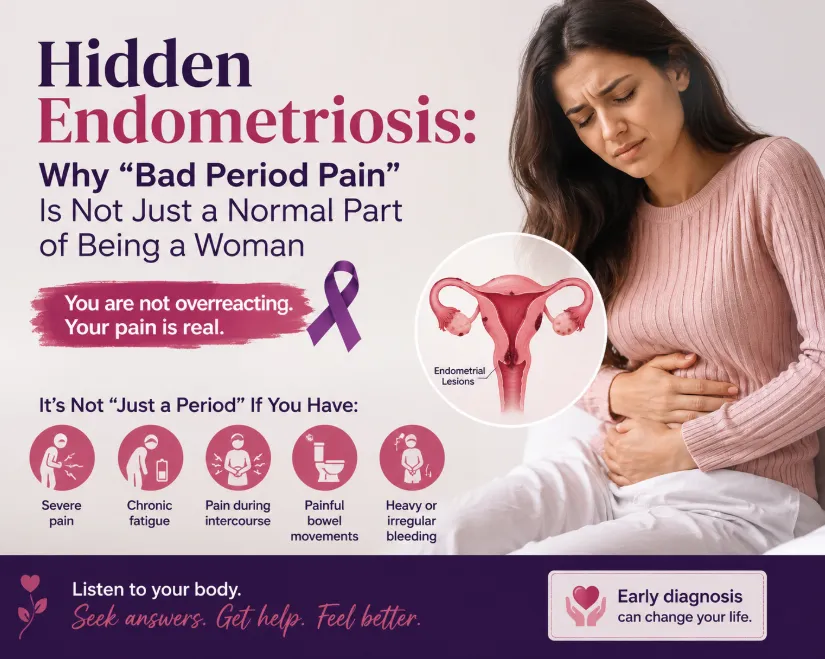
Endometriosis happens when tissue similar to the lining inside the uterus begins growing outside the uterus.
This tissue may appear on:
● Ovaries
● Fallopian tubes
● Pelvic lining
● Bowel or bladder areas in severe cases
Like the uterine lining, this tissue responds to hormonal changes during the menstrual cycle.
The difference?
It has nowhere to go.
That can trigger:
● Inflammation
● Scarring
● Adhesions (internal tissue sticking together)
● Chronic pelvic pain
● Fertility challenges
In simple terms, endometriosis is not “just bad cramps.”
It is a chronic medical condition that deserves proper attention.
The Cultural Problem: Why Women Are Told to “Just Tolerate It”
In many Indian homes, painful periods are treated almost like a rite of passage.
“You’ll get used to it.”
“After marriage, it’ll improve.”
“Pain during periods is normal.”
As a result, many women delay seeking medical care for years.
The problem is not mild discomfort.
Periods can absolutely feel uncomfortable.
But there is a difference between:
Expected discomfort and Pain that disrupts life.
If someone is:
● Missing school or work
● Vomiting from pain
● Fainting during periods
● Unable to stand upright
● Requiring strong painkillers every month
That deserves medical attention.
Pain severe enough to interrupt daily life should never be dismissed automatically.
And yet, many women spend years feeling unheard.
Why Endometriosis Often Goes Undiagnosed
One of the most frustrating realities of endometriosis is how difficult it can be to identify.
Some women have severe pain but normal scans.
Others have fertility problems with almost no symptoms.
There is no single symptom checklist that applies to everyone.
Common signs may include:
● Severe menstrual pain
● Pain during intercourse
● Heavy bleeding
● Pelvic pain outside periods
● Bloating (“endo belly”)
● Pain during bowel movements during menstruation
● Difficulty conceiving
Because symptoms overlap with PCOS, digestive disorders, or “regular cramps,” diagnosis is often delayed.
In fact, many women are diagnosed only after fertility struggles begin.
At a trusted IVF hospital in chennai, fertility specialists often evaluate underlying conditions like endometriosis when patients experience unexplained infertility or long-standing menstrual pain.
Because sometimes, the fertility issue did not suddenly appear.
It was quietly developing for years.
The Hidden Fertility Connection
One of the biggest misconceptions about endometriosis is this:
“If my periods are regular, fertility should be fine.”
Not necessarily.
Endometriosis can affect fertility in several ways:
1. Inflammation in the Pelvic Environment
Chronic inflammation may affect egg quality, sperm movement, and embryo implantation.
2. Scarring Around Fallopian Tubes
Severe endometriosis may distort pelvic anatomy or interfere with egg transport.
3. Ovarian Endometriomas
In some cases, ovarian cysts linked to endometriosis can impact ovarian reserve.
4. Implantation Challenges
Changes in the uterine environment may influence pregnancy outcomes.
This does not mean pregnancy becomes impossible.
Many women with endometriosis conceive naturally.
Others may benefit from fertility support depending on severity and age.
The important thing is recognising the problem early instead of normalising suffering.
“But My Mother Had Pain Too…”
This is another reason endometriosis gets missed.
Many women inherit not just genetics – but beliefs.
If mothers, sisters, or relatives also suffered silently, pain becomes normalised inside families.
But shared suffering does not automatically mean normal health.
It may simply mean the condition was never identified across generations.
Modern women are increasingly asking an important question:
“What if my body is trying to tell me something?”
That shift matters.
Because earlier diagnosis can often lead to better symptom management and fertility planning.
When Should You See a Fertility Specialist?
Not every painful period means endometriosis.
But certain patterns deserve evaluation.
You should consider speaking with a doctor if:
● Pain worsens month after month
● Painkillers stop helping
● Daily activities become difficult
● You have been trying to conceive without success
● Pain affects work, sleep, or relationships
Understanding fertility health early matters – especially if pregnancy is part of your future plan.
For women navigating unexplained fertility concerns, understanding the right timing for intervention can help avoid unnecessary delays.
The Emotional Side Nobody Talks About
Living with chronic pain changes people.
Many women with undiagnosed endometriosis quietly experience:
● Exhaustion
● Anxiety around periods
● Reduced confidence
● Relationship strain
● Emotional burnout from feeling dismissed
Some begin doubting themselves.
“Maybe I’m overreacting.”
“Maybe everyone handles pain better.”
But medical pain is not weakness.
And asking questions about your health is not overdramatic.
At the best fertility hospital in chennai, fertility care increasingly includes conversations about underlying reproductive conditions because symptoms often extend far beyond fertility alone.
Because women deserve answers – not dismissal.
Final Thought
Some discomfort during periods can be normal.
But suffering in silence should never be.
If pain repeatedly interrupts your life, your work, your emotional wellbeing, or your fertility journey, it deserves attention.
Because “bad periods” are not always just bad periods.
Sometimes, they are the body asking to be heard.
And the earlier women stop normalising extreme pain, the earlier they can access the care, clarity, and support they deserve.